

Introduction
You watch a six-figure account go dark. The renewal date passes, and the logo disappears from your dashboard. Your model did flag them as 'low risk' right up until they left.
That monthly churn report is a post-mortem, and by the time you read it, the damage is done. Traditional churn models chase broad accuracy.
They miss the rare, expensive customer who is silently walking away. You get foresight by re-wiring your detection system to monitor the real-time behavioral tremors that precede an earthquake, and ignoring the survey scores that stayed green the whole time.
Key Takeaways
Churn prediction feels too late because most systems run on a foundation of lagging data and cost-blind metrics. Transitioning to a proactive posture requires a fundamentally different technical and operational architecture.
- Lagging indicators cost you money: Models relying on yesterday's CRM data and quarterly surveys systematically miss the 4 to 6 week behavioral slide that precedes a cancellation.
- You are missing the right data streams: Streaming data from product usage, support sentiment, and billing anomalies are the early-warning signals. Static firmographics arrive after the decision is already made.
- AI health scoring is the translation layer: A self-learning model ingests those streams to detect composite behavioral shifts, like feature abandonment, that are impossible for a human to spot manually.
- Close the action gap with automation: Manual outreach on alerts fails because of human delay. Automated playbooks that trigger the right intervention the moment risk is confirmed are the only way to scale a retention motion.
The Core Problem: Why Churn Prediction Feels Too Late

Traditional churn models are built on a fundamental lie. They assume a false alarm and a missed save cost the same thing. They don't.
In customer retention, the unit classification costs have substantial imbalances. A model tuned for overall accuracy is perfectly happy to ignore your enterprise logos as long as it correctly labels the vast majority of stable accounts. You are grading a cancer screening tool by how well it identifies healthy patients.
This is a fatal asymmetry. A model optimized for the metric that looks best on a slide deck will silently filter out the rare, catastrophic event.
By the time the data confirms the churn, the decision is already weeks old. The customer hit a dead end in your product, encountered a specific integration error twice within a week, or simply stopped using a core feature. That behavioral slide can begin 4 to 6 weeks before a contract ends, and it simply doesn't appear in your monthly billing report. If you are only monitoring contract dates and NPS scores, you are reacting to a murder after the body has been buried. You feel too late because you are looking at the wrong metrics, at the wrong time, with a model that was never designed to value the cost of a loss.
The Data Blind Spot: Siloed and Static Information
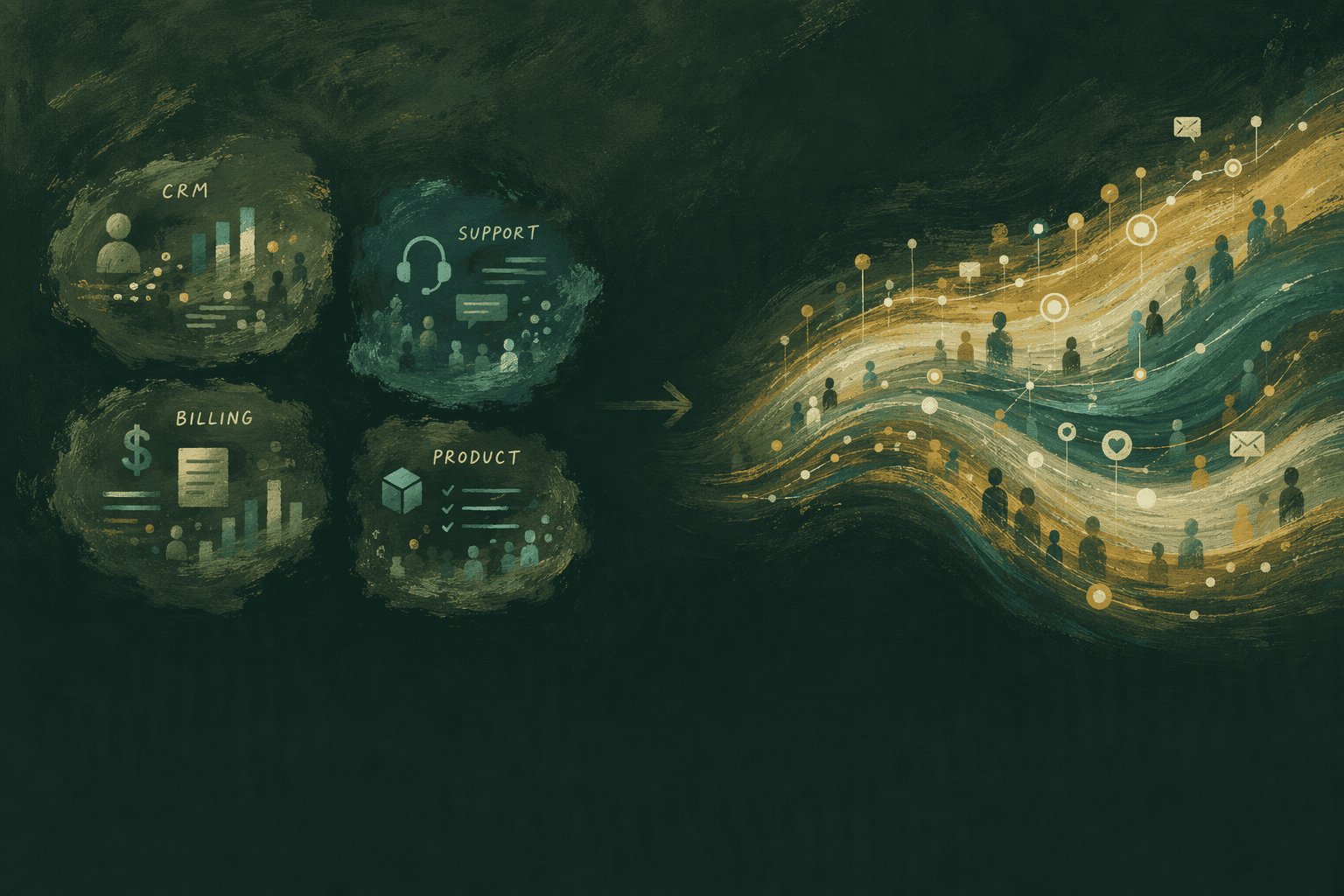
You are likely running blind because your data is an archaeological dig, not a live feed. Most models lack temporal features that capture changes in customer behavior over time, such as frequency of support interactions or payment delays. Research shows that many companies struggle with sentiment measurement: a significant portion don't measure sentiment at all, and many measure only once a year. That's an annual check-in in a 24/7 digital marketplace.
The missing ingredient isn't more data. It's the right connected data. You need streaming signals from four specific categories: product usage velocity, support ticket sentiment, billing anomalies, and login patterns.
Usage velocity tracks a drop in how often someone relies on a core feature. Sentiment analysis catches when questions shift from 'how to' to 'why isn't this fixed.'
Billing flags a downgrade in plan modules, and login patterns surface a champion who stops showing up. Without this real-time composite, your health score is just a vanity snapshot of the historical record.
The Mechanism: How Real-Time Health Scoring Transforms Detection

Churn probability is not a static attribute. It is a dynamic condition that shifts with every support call, every login, and every feature click.
An AI-driven health scoring system operates like a continuous EKG for your customer base. It ingests streaming data and recomputes a risk profile in real time. Unlike a rule-based 'if usage drops below X, fire an alert' logic, this detects composite shifts. For instance, it correlates a slight dip in product usage velocity with a spike in negative support sentiment and a new hiring freeze signal from the customer's public market data, surfacing a risk that no single dashboard widget would ever catch.
An effective AI-driven health scoring system aggregates signals from your CRM, support platform, product analytics, and communication tools into a real-time score that learns which patterns predict churn for your specific business. The system doesn't just monitor high-level account health; it flags specific leading indicators like a champion's departure, usage down 8% and a health score of 62, or a situation where health score drops to 43, usage falls 19%, and 3 escalated support tickets trigger an immediate 'churn intervention' suggestion. By turning raw behavior into a leading, actionable signal, you stop the monthly autopsy and start daily diagnosis.
Even a perfect detection model is useless if no one acts on it. The 'action gap' is the lethal delay between a risk signal firing and a human CSM manually executing a play. Follow this logic to close it.
- Unify the signal: Aggregates alerts into a single, opinionated queue so teams aren't paralyzed by noise from seven different dashboards.
- Assign context-aware playbooks: Automates the attachment of a rescue playbook based on the root cause signal, whether it's an adoption drop or a billing issue.
- Trigger the low-touch layer: Execute automated, personalized outreach from the CSM's inbox for low-confidence risks or mid-tier accounts immediately, bypassing the manual 'will I have time today' bottleneck.
- Trigger the high-touch layer: Route high-confidence risks on VIP accounts to the CSM with an AI-generated draft email, relevant error logs, and a suggested call script, reducing mental context-switching costs.
- Escalate aged actions: Automatically pushes an action to a manager or closes the loop if it ages out without being addressed. The system is a closed loop, so nothing rots in a backlog.
Reducing Noise: Conquering False Positives with Precision

An alert that screams wolf drowns out the signal you need to hear. Intelligent routing aims for precision recall. Without it, your team chases ghosts while a real crisis unfolds unnoticed.
Confidence thresholds and customer tiering let you stop treating a disengaged free user the same way you treat a threatened power-user. A low-value account that opens three support articles in a week might just be curious. A power-user who suddenly stops using a core feature after two years of daily activity is a fire that needs immediate attention.
A churn model trained on behavioral signals surfaces both patterns. The art is what you do next: suppress the first alert, or route it to an automated email sequence, while the second should trigger a direct Slack notification to the account's CSM within minutes. FullStory highlights that behavioral signals often flag risk long before a usage dashboard shows a dip, which makes fast triage the difference between a saved account and a lost one.
The routing logic lives in the gap between what the model sees and what the business can afford to act on. That gap closes when you map every predicted risk score to a tiered response that respects both the account's revenue footprint and the team's bandwidth.
Here is how intelligent segmentation works:
| Segmentation Tactic | Low-Value / Free User | High-Value / Threatened Power-User |
|---|---|---|
| Confidence Threshold | High bar required before triggering an alert; suppress low-probability indicators. | Medium to low bar; catch early-warning signals even if the model probability is modest. |
| Alert Priority | Route to self-serve resources or automated email sequences to filter noise. | Escalate immediately to a human CSM or an on-call retention specialist in Slack. |
| Routing Channel | In-app tooltip, knowledge-base link, or queued batch notification. | Real-time push via high-priority ticket, SMS, or direct outreach workflow. |
| Follow-up Cadence | One automated touchpoint, then pause; avoid exhausting scarce team focus. | Persistent, multi-channel sequence (call, email, LinkedIn) within a defined 24-hour window. |
| Goal | Deflect cost at scale; let the product self-resolve minor friction. | Precision recall; maximize retention revenue by treating the risk as a crisis. |
Building an End-to-End Proactive Churn Defence

Escaping the 'too late' trap isn't about buying a single magic tool. It requires wiring together a defensible system that detects, directs, and auto-corrects through these steps:
- Unify streaming data sources: Connect CRM, product analytics, billing, and support platforms into a single temporal feed because insights trapped in silos are just lagging indicators in disguise.
- Deploy a self-learning health-scoring model: Weigh not just declining usage, but also market signals like leadership changes monitored across professional networks and news sources to prevent silent champion loss.
- Implement tier-based automated playbooks: Trigger the correct intervention so an at-risk power user gets a phone call, not a generic email, within minutes of confirmation.
- Create a strict feedback loop: Ensure saved and lost outcomes directly retrain the model, moving the system from a brittle, rules-based detector to a custom prediction engine that sharpens with every churn event you prevent or fail to stop.
This architecture is the difference between a monthly autopsy of lost logos and a daily retention advantage.
Conclusion
Predicting churn feels too late when you rely only on static, retrospective data and wait for a human to manually flag the risk. By the time a customer cancels, their behavior has been telegraphing intent for weeks. More surveys won't change that. What stops churn is a connected, automated system that reads behavioral signals as they stream in, recalculates risk on the fly, and triggers action without human delay. That shift moves you from post-mortem cleanup to keeping real accounts alive.
Frequently Asked Questions
Sources
- Optimized customer churn prediction using tabular generative adversarial network (GAN)-based hybrid sampling method and cost-sensitive learning - PMC - pmc.ncbi.nlm.nih.gov
- Enhancing customer retention with machine learning: A comparative analysis of ensemble models for accurate churn prediction - ScienceDirect - www.sciencedirect.com
- Predicting Customer Churn with Behavioral Signals | What Statistical Models Miss - www.fullstory.com


